

Why Semiconductors Matter More Than Ever
Computer chips, also known as semiconductors, are the backbone of modern technology. From smartphones and broadband networks to cars, defence systems, and data centres, almost every digital system depends on a reliable supply of chips.
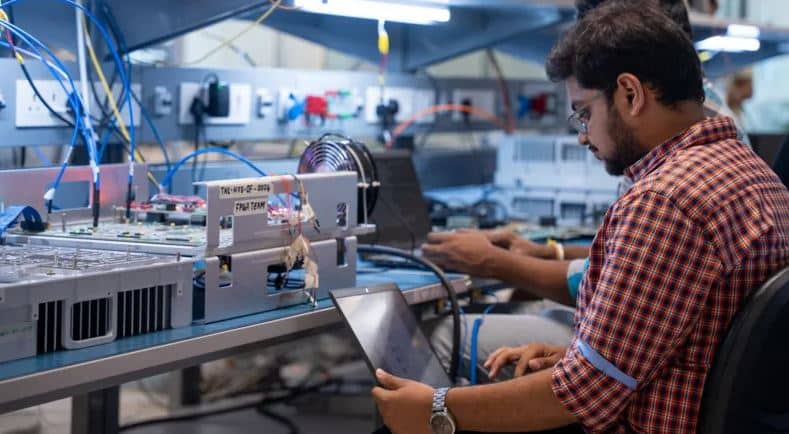
For Indian technology companies like Tejas Networks, chip availability is not just a cost issue nit’s a survival issue.
“Telecom chips are fundamentally different from consumer chips,” says Arnob Roy, co-founder of Tejas Networks. “They must handle massive data loads from hundreds of thousands of users, without ever failing.”
India’s Hidden Strength: Chip Design Talent
India already plays a crucial role in the global semiconductor design ecosystem.
- Nearly 20% of the world’s semiconductor engineers are based in India
- Almost every major global chipmaker runs large design centres in cities like Bengaluru, Hyderabad, and Noida
- Indian engineers work on cutting-edge chip architectures used worldwide
“India is exceptionally strong in chip design,” says Amitesh Kumar Sinha from the Ministry of Electronics and IT. “What we lack is large-scale chip manufacturing.”
The Big Gap: Manufacturing Still Happens Abroad
Despite strong design capabilities, most chips designed in India are manufactured overseas, mainly in Taiwan and parts of East Asia.
This weakness was exposed during the Covid-19 pandemic, when global supply chains broke down and chip shortages crippled industries worldwide.
“The pandemic showed how dangerous it is to depend on a few countries for such a critical technology,” Roy explains.
That moment became a turning point for India’s semiconductor ambitions.
India’s Strategy: Start With Packaging, Not Fabs
Making advanced chips requires multi-billion-dollar factories called fabs, using extremely complex and costly equipment. Competing directly with Taiwan or South Korea is unrealistic in the short term.
Instead, India is taking a phased approach.
Assembly, Testing and Packaging (OSAT)
India is focusing first on Outsourced Semiconductor Assembly and Test (OSAT) – the stage where wafers are cut, packaged, and tested.
“Assembly and testing are easier to start than wafer fabrication,” says Ashok Chandak of the India Electronics and Semiconductor Association. “This is where India can scale quickly.”
Several OSAT plants are expected to reach mass production this year.
Kaynes Semicon: India’s First Big Leap
Founded in 2023, Kaynes Semicon became the first company to operationalise a semiconductor facility with government support.
- $260 million investment
- Located in Gujarat
- Began production in late 2025
“Packaging is not just putting a chip in a box,” says CEO Raghu Panicker. “It’s a 10–12 step manufacturing process. Without it, the chip is useless.”
Focus on Strategic Chips, Not AI Hype
India is not aiming to make the world’s most advanced AI or smartphone chips—at least not yet.
Instead, production will focus on chips used in:
- Automobiles
- Telecommunications equipment
- Defence and aerospace systems
“These may not be glamorous chips,” Panicker says, “but they are economically and strategically critical for India.”
The Real Challenge: Skills and Culture
Building a semiconductor ecosystem isn’t just about money or machines.
“The biggest bottleneck is skilled manpower,” Panicker admits.
“You can’t compress five years of experience into six months.”
Semiconductor manufacturing demands:
- Extreme precision
- Strict process control
- A culture of documentation and discipline
India is still in the early stages of developing this mindset at scale.
What the Future Looks Like for India’s Chip Industry
Industry leaders remain cautiously optimistic.
Over the next decade, India is expected to:
- Build a strong semiconductor packaging and testing base
- Reduce dependence on foreign chip supply
- Gradually move into end-to-end chip manufacturing
“I do see Indian companies eventually designing and manufacturing complete telecom chipsets,” Roy says. “But deep-tech takes patience, capital, and time.”
Conclusion: A Long Journey, But a Real One
India may not become a semiconductor superpower overnight, but it has begun laying the foundation. With strong design talent, growing government support, and early manufacturing wins, the country is finally entering the global chip race step by step.
The journey will be slow, complex, and expensive. But for India, the cost of not building a chip ecosystem is far greater.